A peptide calculator converts three numbers into the one you need at the syringe: vial strength, the volume of bacteriostatic water you added, and the dose your protocol specifies. It returns concentration in mg/mL, the volume of a single dose in mL, how many doses the vial holds, and where that volume sits on a U-100 insulin syringe scale.
That last conversion is where most of the mistakes happen, and it isn't a peptide-specific problem. Anyone drawing up injectable estradiol or testosterone at home runs the same arithmetic with the reconstitution step removed. This page gives the formulas, works them through, and checks every number. It is arithmetic, not a protocol. The dose comes from whoever prescribes it, and research peptides are research-use compounds with no approved human dose at all.
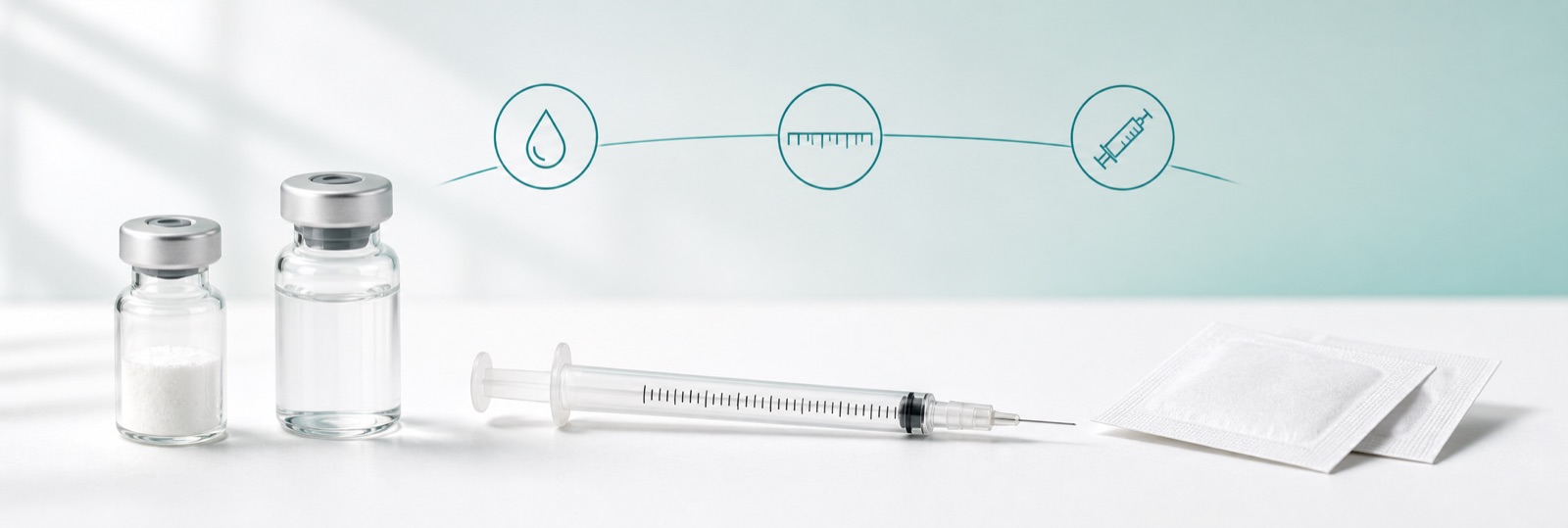
What a peptide calculator actually computes
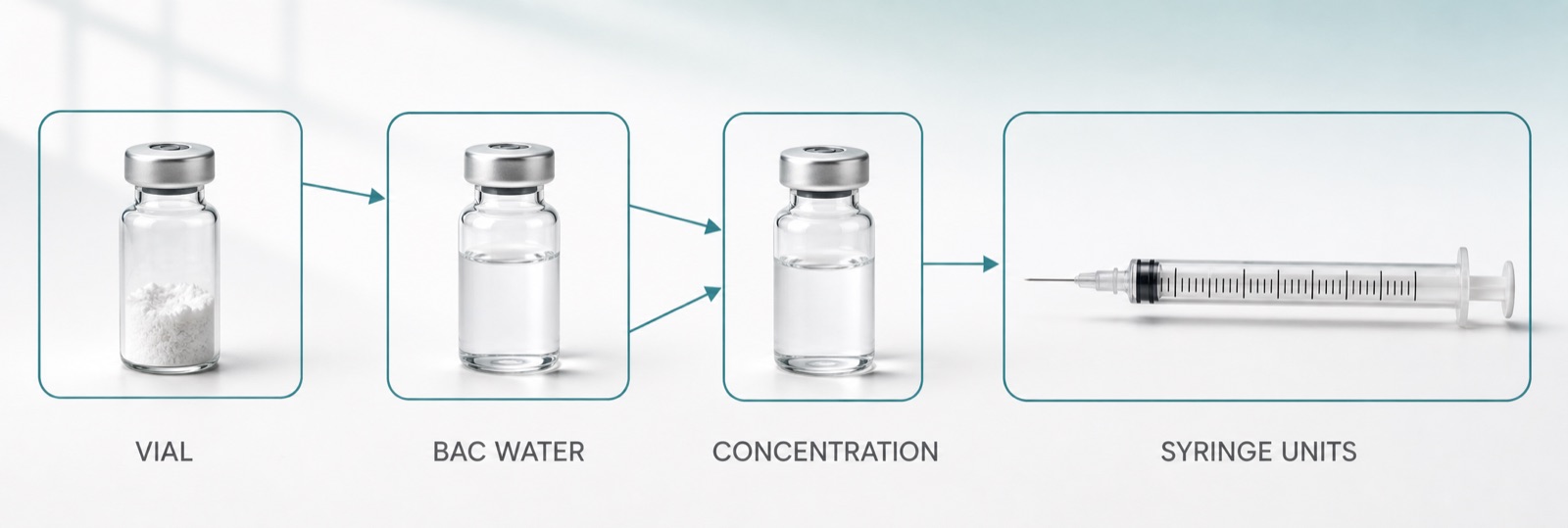
A peptide calculator is a reconstitution and dose-conversion tool, not a dosing recommender. You give it four inputs: the syringe you are using (a U-100 insulin barrel in 1 mL, ½ mL or ⅓ mL), the vial size in milligrams, how much bacteriostatic water you plan to add, and the dose you want in micrograms or milligrams. It gives back concentration, volume per dose, doses per vial, and the unit mark to draw to.
Five lines of arithmetic do all of it:
concentration (mg/mL) = vial strength (mg) / BAC water volume (mL)
injection volume (mL) = dose (mg) / concentration (mg/mL)
U-100 syringe units   = injection volume (mL) x 100
doses per vial        = vial strength (mg) / dose (mg)
1 mg                  = 1000 mcg
Run them once and the shape becomes obvious. A 5 mg vial reconstituted with 2 mL of bacteriostatic water gives 5 / 2 = 2.5 mg/mL. A 250 mcg dose is 0.25 mg, so the injection volume is 0.25 / 2.5 = 0.1 mL, which is 0.1 x 100 = 10 units on a U-100 syringe. The vial holds 5 / 0.25 = 20 doses.
Doing that by hand for one vial is easy. Doing it correctly at 2am, half asleep, after switching vial sizes, is where people slip a decimal. If you want the numbers checked for you, PeptideDeck publishes a free peptide calculator that takes those same four inputs and returns concentration, volume per dose, doses per vial and the U-100 unit mark, with presets for BPC-157, TB-500, CJC-1295 (No DAC), Ipamorelin, Retatrutide, GHK-Cu, MOTS-c and Semax so you are not typing vial strengths from memory.
What is a unit on a U-100 insulin syringe?
A unit on a U-100 insulin syringe is a volume marking. U-100 means the barrel is calibrated for insulin at a strength of 100 units per millilitre, so one mark is one hundredth of a millilitre: 0.01 mL. That is the entire definition.
A unit is not a milligram. It is not a microgram. It is not an international unit of anything. This is the single most common misunderstanding in home injecting, and it is worth being blunt about, because the error is silent. Nothing on the syringe tells you that you got it wrong.
How much drug sits in one unit depends entirely on the concentration in the vial:
| Concentration in the vial | What 1 unit (0.01 mL) delivers |
|---|---|
| 1 mg/mL | 10 mcg |
| 1.25 mg/mL | 12.5 mcg |
| 2 mg/mL | 20 mcg |
| 2.5 mg/mL | 25 mcg |
| 4 mg/mL | 40 mcg |
| 5 mg/mL | 50 mcg |
| 10 mg/mL | 100 mcg |
| 20 mg/mL | 200 mcg |
Each row is the same sum: 0.01 mL multiplied by the concentration in mg/mL, converted to micrograms. At 2.5 mg/mL, 0.01 x 2.5 = 0.025 mg, and 0.025 mg is 25 mcg. Read "10 units" as "10 mg" at that concentration and you have overestimated what you drew by a factor of 40, because 10 units actually delivers 0.25 mg.
Two other facts about the barrel matter. Capacity is set by volume, so a 1 mL U-100 barrel tops out at 100 units, a ½ mL barrel at 50 units, and the smallest common barrel, sold as ⅓ mL or 3/10 mL, is marked to 30 units, which is 0.3 mL. And U-40 syringes still exist, mostly for veterinary insulin. On a U-40 barrel each mark is 1/40 of a millilitre, so drawing to the 10 mark gives 0.25 mL rather than the 0.1 mL you would get on U-100. That is 2.5 times the intended volume from a syringe that looks almost identical. Check the barrel says U-100 before you use it.
How do you calculate peptide dosage from a reconstituted vial?
Reconstituting a peptide means adding bacteriostatic water to a vial of lyophilised powder to make a solution you can measure. The powder's mass never changes. All you are choosing is how much liquid to dissolve it in, and that choice sets the concentration, which sets how many units one dose occupies.
Every row below was computed from the four formulas and checked with exact fractional arithmetic, no rounding anywhere:
| Vial | BAC water | Concentration | Dose | Injection volume | U-100 units | Doses per vial |
|---|---|---|---|---|---|---|
| 5 mg | 2 mL | 2.5 mg/mL | 250 mcg | 0.1 mL | 10 units | 20 |
| 5 mg | 1 mL | 5 mg/mL | 500 mcg | 0.1 mL | 10 units | 10 |
| 10 mg | 2 mL | 5 mg/mL | 250 mcg | 0.05 mL | 5 units | 40 |
| 10 mg | 4 mL | 2.5 mg/mL | 500 mcg | 0.2 mL | 20 units | 20 |
| 15 mg | 3 mL | 5 mg/mL | 1 mg | 0.2 mL | 20 units | 15 |
| 20 mg | 5 mL | 4 mg/mL | 400 mcg | 0.1 mL | 10 units | 50 |
| 30 mg | 3 mL | 10 mg/mL | 1.5 mg | 0.15 mL | 15 units | 20 |
Take row four to see the chain end to end. Concentration is 10 / 4 = 2.5 mg/mL. The dose of 500 mcg is 0.5 mg, so volume is 0.5 / 2.5 = 0.2 mL, and 0.2 x 100 = 20 units. Doses per vial is 10 / 0.5 = 20.
There is a shortcut worth knowing, because it lets you sanity-check a calculator's answer in your head. The total volume you put into the vial, expressed in units, is the BAC water volume times 100. Whatever fraction of the vial one dose represents, you draw that same fraction of those units. A 10 mg vial dosed at 500 mcg is 1/20 of the vial per dose. With 4 mL of water in it, the vial holds 400 units, and 1/20 of 400 is 20 units. Same answer, no division by a decimal.
How much bacteriostatic water should you add?
Enough to land your dose on a mark you can read, and no rule beyond that. Adding more water does not add or remove drug, and it does not change how many doses the vial contains. It changes only the volume each dose occupies.
Here is one 5 mg vial and one 250 mcg dose at four different dilutions:
| BAC water added | Concentration | Injection volume | U-100 units | Doses per vial |
|---|---|---|---|---|
| 1 mL | 5 mg/mL | 0.05 mL | 5 units | 20 |
| 2 mL | 2.5 mg/mL | 0.1 mL | 10 units | 20 |
| 4 mL | 1.25 mg/mL | 0.2 mL | 20 units | 20 |
| 5 mL | 1 mg/mL | 0.25 mL | 25 units | 20 |
The last column never moves. Twenty doses in every row, because 5 / 0.25 = 20 regardless of what you diluted it with. That is the fact that trips people up, in both directions: some assume more water stretches the vial further, others worry it weakens the dose. Neither happens.
What does change is precision. At 5 mg/mL a dose is 5 units, so misreading by half a mark costs 25 mcg, a tenth of the dose. At 1.25 mg/mL the same dose is 20 units and the same half-mark misread costs 6.25 mcg. More dilute solutions spread the dose across more marks, which makes small doses easier to draw accurately. The limits are the barrel, since 100 units is the ceiling on a 1 mL syringe, and the fact that a reconstituted vial has a finite refrigerated shelf life, so a vial you dilute heavily needs to be one you will finish.
Injectable HRT and TRT use the same arithmetic
This is the part that transfers, and it is why the conversion matters well beyond peptides. Injectable hormone preparations arrive already in solution, so there is no reconstitution step and no bacteriostatic water decision. The concentration is printed on the label. Everything after that is identical: divide the dose by the concentration to get millilitres, multiply by 100 to get U-100 units.
| Preparation | Label concentration | Dose | Injection volume | U-100 units |
|---|---|---|---|---|
| Testosterone cypionate | 200 mg/mL | 100 mg | 0.5 mL | 50 units |
| Testosterone cypionate | 200 mg/mL | 60 mg | 0.3 mL | 30 units |
| Testosterone cypionate | 100 mg/mL | 75 mg | 0.75 mL | 75 units |
| Testosterone enanthate | 200 mg/mL | 50 mg | 0.25 mL | 25 units |
| Estradiol valerate | 20 mg/mL | 4 mg | 0.2 mL | 20 units |
| Estradiol valerate | 40 mg/mL | 10 mg | 0.25 mL | 25 units |
| Estradiol cypionate | 5 mg/mL | 2 mg | 0.4 mL | 40 units |
Look at rows one and three. Both are testosterone cypionate, both are a legitimate labelled strength, and a 100 mg dose from the 200 mg/mL vial is half a millilitre while a 75 mg dose from the 100 mg/mL vial is three quarters of one. The number of units you draw depends on which concentration you were dispensed, not on the drug. Estradiol valerate makes the same point harder: rows five and six are both estradiol valerate, and the 4 mg dose from a 20 mg/mL vial and the 10 mg dose from a 40 mg/mL vial land within 5 units of each other despite one being more than double the other.
So if your pharmacy switches you between concentrations at a refill, the volume you have been drawing for months is now wrong even though the prescription didn't change. Read the concentration on every new vial and redo the division. Our HRT dosage chart lists the labelled strengths across oral, patch, gel and injectable routes if you want to see where a given number sits.
Two practical caveats. Insulin syringes are fine for aqueous subcutaneous injections but their fine gauge draws thick oil-based preparations slowly, which is why intramuscular testosterone is often drawn with a wider needle and injected with a narrower one. And the unit scale is still only a volume scale, so a 1 mL barrel cannot hold a 1.5 mL dose no matter what the calculator says.
How many units is 250 mcg?
There is no single answer, and any page that gives you one without asking about concentration is guessing. A microgram is a mass and a unit is a volume, so the conversion runs through the concentration in the vial in front of you.
At 2.5 mg/mL, 250 mcg is 10 units. At 5 mg/mL the same 250 mcg is 5 units. At 1 mg/mL it is 25 units. The dose is the same in all three; the vial is different. Working it out is 0.25 mg divided by the concentration, times 100.
This is why "how many units is 250 mcg" cannot be answered from a chart alone, and why swapping to a differently sized vial without recalculating is the most reliable way to get the dose wrong.
Five ways this arithmetic goes wrong
- Reading units as milligrams. Ten units at 2.5 mg/mL is 0.25 mg. Treating it as 10 mg overstates the dose 40-fold. Units are volume.
- Mixing up mcg and mg. A dose entered as 250 mg instead of 250 mcg is off by a factor of 1000. Convert first, then divide.
- Using a U-40 barrel. Each mark is 0.025 mL rather than 0.01 mL, so the same number of marks is 2.5 times the volume.
- Assuming more water means more doses. It doesn't. Doses per vial is vial strength divided by dose, and bacteriostatic water appears nowhere in that formula.
- Not redoing the sum after a concentration change. New vial size, different dilution, or a pharmacy switching you between labelled strengths all invalidate the unit mark you memorised.
What the half-life and microdosing modes do
The PeptideDeck tool carries two modes beyond reconstitution, and both are worth knowing exist because they answer questions the main calculator can't.
The half-life mode models how much of a dose is still present over time. The maths is one line: after each half-life, half of what remained is gone. So 50% remains after one half-life, 25% after two, 12.5% after three and 6.25% after four. For a compound with a half-life near a week, such as semaglutide, that is why a weekly schedule accumulates toward a steady level rather than starting from zero each time, and why a missed dose doesn't empty the system.
The microdosing mode splits a protocol's total across a schedule: daily, every other day, or five days on with two off. That is division, and it is worth checking rather than eyeballing. A 1400 mcg weekly total is 200 mcg across seven daily injections, 280 mcg across five, or 400 mcg if you inject every other day and land 3.5 times a week on average. Same weekly total, three different amounts in the syringe.
Frequently Asked Questions
What does a peptide calculator do?
A peptide calculator converts a vial strength, a volume of bacteriostatic water and a target dose into the numbers you use at the syringe. It returns concentration in mg/mL, the injection volume in mL, how many doses the vial holds, and the mark to draw to on a U-100 insulin syringe. It does not decide your dose. That comes from whoever prescribes or specifies the protocol.
Is a unit on an insulin syringe the same as a milligram?
No, and this is the most common error in home injecting. A unit on a U-100 syringe is a volume marking equal to 0.01 mL, one hundredth of a millilitre. How much drug that contains depends on the concentration in the vial. At 2.5 mg/mL one unit holds 25 mcg; at 10 mg/mL the same mark holds 100 mcg. Units are never milligrams and never international units.
How many units is a 250 mcg dose?
It depends on concentration, so the question has no fixed answer. A 250 mcg dose is 0.25 mg. Divide that by the concentration to get millilitres, then multiply by 100. At 2.5 mg/mL that is 10 units, at 5 mg/mL it is 5 units, and at 1 mg/mL it is 25 units. Recalculate whenever the vial or the dilution changes.
Does adding more bacteriostatic water make a vial last longer?
No. Doses per vial is vial strength divided by dose, and the water volume is not in that formula. A 5 mg vial dosed at 250 mcg yields 20 doses whether you added 1 mL or 5 mL. Extra water only spreads each dose across more syringe marks, which improves reading accuracy for small doses but does not add drug.
Does the same arithmetic apply to injectable estradiol or testosterone?
Yes, minus the reconstitution step. Those arrive in solution with the concentration printed on the label, so you divide the prescribed dose by that concentration and multiply by 100. A 100 mg dose from a 200 mg/mL testosterone cypionate vial is 0.5 mL, which is 50 units. Recheck it at every refill, because the same prescription at a different labelled strength is a different volume.
Can a calculator tell me what dose to take?
No. A calculator handles unit conversion only and has no knowledge of you, your labs or your history. Injectable hormone therapy is prescribed and monitored, and research peptides have no approved human dosing at all. Use the arithmetic to carry out a dose someone qualified has specified, and take any question about the dose itself to them.
What to do next
Write down three numbers before you touch a vial: the strength on the label, the volume of water you are adding, and the dose you have been told to take. Divide the first by the second for concentration, divide the dose by that for millilitres, multiply by 100 for units. Then check it a second way with the fraction shortcut, or against a calculator, and confirm the answer fits the barrel you own.
If you are researching peptides alongside hormone therapy rather than working out a syringe mark, our comparison of peptide and GLP-1 information sources covers which references publish real dosing detail and which deliberately don't. If you are injecting without a prescriber, read the risks in our guide to DIY HRT first, and the side effects worth monitoring on TRT if testosterone is what you are drawing.
Sources
- The PeptideDeck reconstitution and dose-conversion tool, linked once in the section above
- MedlinePlus: testosterone injection
- DailyMed labels for testosterone cypionate, source for the 100 and 200 mg/mL strengths above
- DailyMed labels for estradiol valerate, source for the 20 and 40 mg/mL strengths above
- DailyMed label for Depo-Estradiol, estradiol cypionate, source for the 5 mg/mL strength above
- CDC: safe injection practices
- FDA: concerns with unapproved GLP-1 drugs used for weight loss