Knowing exactly where to place estradiol patch products determines how consistently your body absorbs hormone therapy and prevents skin irritation. The primary approved application sites are the lower abdomen (below the waistline) and the upper outer quadrant of the buttocks. You must never apply an estradiol patch to the breasts or chest area, as local estrogen exposure to breast tissue increases health risks.
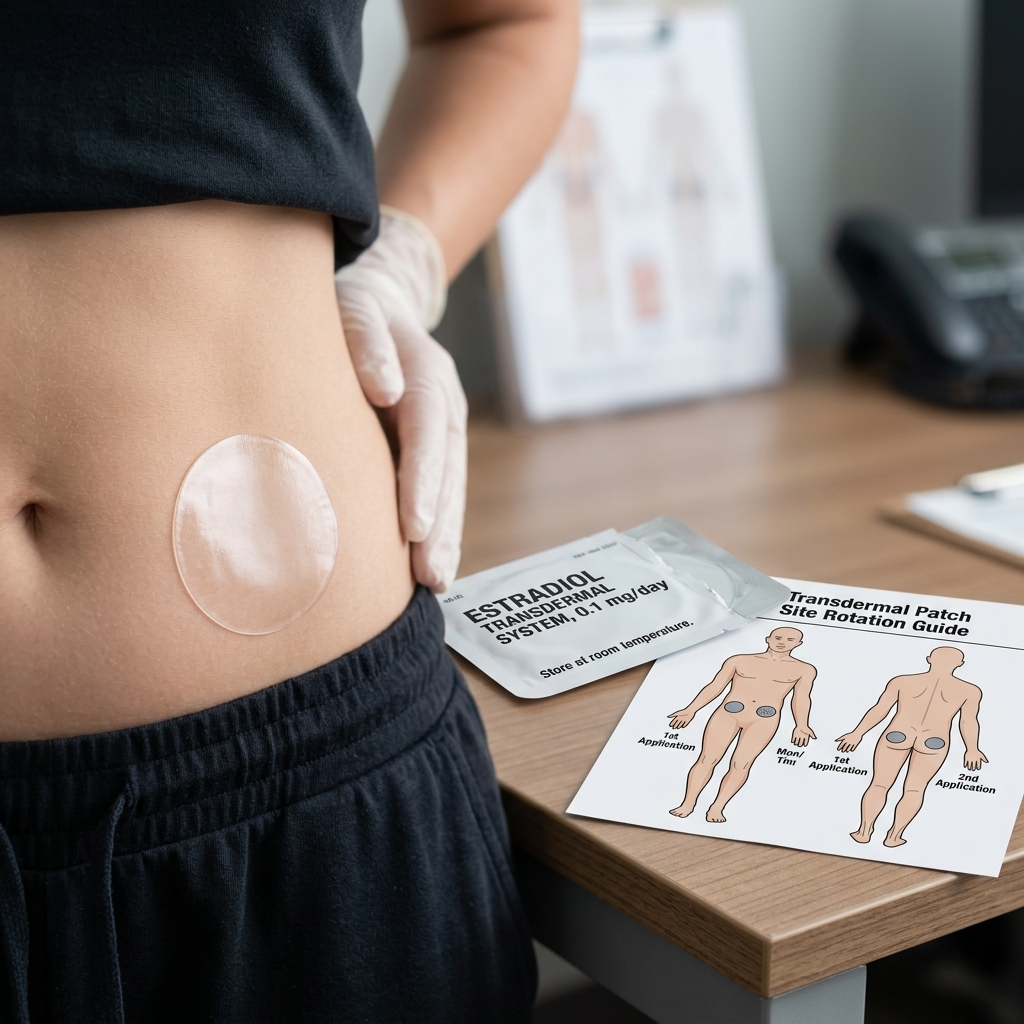
Transdermal delivery is widely favored over oral tablets among best hrt patches prescribers because absorbed estradiol enters the bloodstream directly, bypassing first-pass liver metabolism and maintaining steady serum concentrations. Understanding the options within hrt types helps patients choose between twice-weekly and weekly patch systems.
Approved vs forbidden placement sites
To ensure safety and optimal drug delivery, follow these anatomical placement guidelines carefully.
Approved primary sites
- Lower Abdomen: Apply below your belly button and below the natural waistline where clothing elastic won't rub against the edges.
- Upper Outer Buttocks / Hip: Apply to the soft flesh on the upper outer quadrant of your buttock. This area often experiences less creasing during sitting than the front abdomen.
Prohibited placement sites
- Breasts or Chest: Never apply patches on or near the breasts. Local tissue concentration can trigger cellular proliferation.
- Waistline / Belt Line: Avoid areas where belts, waistbands, or tight clothing seams cause continuous friction.
- Skin Folds or Hairy Areas: Creases cause patches to buckle, while dense body hair prevents flat contact.
- Irritated, Broken, or Sunburned Skin: Damaged skin alters absorption rates unpredictable ways.
Transdermal absorption kinetics and skin temperature
Estrogen patches rely on passive diffusion through the stratum corneum, the outermost protective skin layer. The rate of hormone transfer depends on skin temperature, hydration levels, and cutaneous blood flow.
Pharmacokinetic studies show that applying the patch to the buttocks results in approximately 15 percent higher average serum estradiol concentrations compared to abdominal application. This occurs because the subcutaneous fat layer on the buttocks provides a more uniform depot and experiences less surface temperature fluctuation throughout the day. When starting therapy per how and when to start hrt, prescribers recommend staying consistent with your chosen general anatomical zone.
Step-by-step application protocol
Proper skin preparation ensures full adhesion for the entire 3.5-day or 7-day wear period.
[Clean & Dry Skin] ➔ [Avoid Moisturizers] ➔ [Press Firmly 10 Secs] ➔ [Rotate Site Next Dose]
- Clean and dry thoroughly: Wash the target site with plain water and mild non-moisturizing soap. Dry completely before application.
- Skip lotions and oils: Do not apply body lotions, body oils, or cream moisturizers to the target site on application day. Residual lipids block adhesive bonding.
- Peel protective backing: Open the pouch, peel off half of the protective plastic backing without touching the adhesive surface with your fingers.
- Apply and hold: Press the exposed adhesive onto the skin, remove the second half of the backing, and press down firmly with the palm of your hand for at least 10 to 15 seconds to heat and activate the adhesive matrix.
Site rotation schedule
Rotating application sites prevents localized skin sensitization, erythema, and adhesive buildup. Patients using bioidentical hormone replacement therapy transdermal formulations follow the same rotation cadence.
| Application Day | Chosen Location | Rotation Notes |
|---|---|---|
| Monday (Dose 1) | Lower Left Abdomen | Keep 2 inches away from navel |
| Thursday (Dose 2) | Upper Right Buttock | Ensure smooth flat skin placement |
| Following Monday | Lower Right Abdomen | At least 1 week since last right-side application |
| Following Thursday | Upper Left Buttock | Cleared previous adhesive residue |
Allowing at least 7 days before returning to the exact same spot gives the skin stratum corneum time to recover fully.
Managing seasonal skin changes and humidity
Hot summer months and cold winter seasons present distinct adhesion challenges:
- Summer / Exercise: Perspiration can loosen matrix adhesives. Applying an overlay medical film (such as Tegaderm) over your estradiol patch protects edges during heavy sweating or lap swimming.
- Winter dryness: Dry, flaky skin reduces surface contact. Moisturize surrounding skin daily, but keep the specific 2-inch patch zone unmoisturized on application days.
Troubleshooting common patch issues
What if my patch starts peeling or comes off?
If an estradiol patch loosens after showering or swimming, press it firmly back in place. If it fails to adhere, apply a fresh patch to a new site and stick to your original scheduled change day. Using medical tape over the patch is approved by prescribers for active swimmers.
How to clean stubborn adhesive residue
Sticky dark rings left behind after patch removal consist of medical adhesive combined with natural skin lipids and lint. Remove residue gently using:
- Baby oil or mineral oil applied on a cotton pad.
- Isopropyl alcohol wipes (followed by moisturizer once the area dries).
- Avoid harsh scrubbing, which damages skin.
Frequently Asked Questions
Can I place my estradiol patch on my thigh?
While lower abdomen and buttocks are FDA-approved sites, some prescribers allow upper outer thigh placement if abdomen and buttocks are unsuitable. Check with your prescriber before placing patches on alternative sites.
Can I swim or take hot baths with an estradiol patch?
Yes. Modern matrix patches are waterproof. However, prolonged exposure to hot tubs or saunas can cause heat-induced dumping (a temporary rapid release of estradiol), so limit intense heat exposure.
Should I take off my old patch before putting on a new one?
Yes. Always peel off and discard the old patch before applying the new patch to avoid doubling your dose.
Sources
- U.S. Food and Drug Administration. (2020). Climara (estradiol transdermal system) Prescribing Information.
- Shufelt, C. L., & Manson, J. E. (2021). Menopausal Hormone Therapy and Transdermal Dosing Options. Contemporary OB/GYN, 66(4), 18-24.